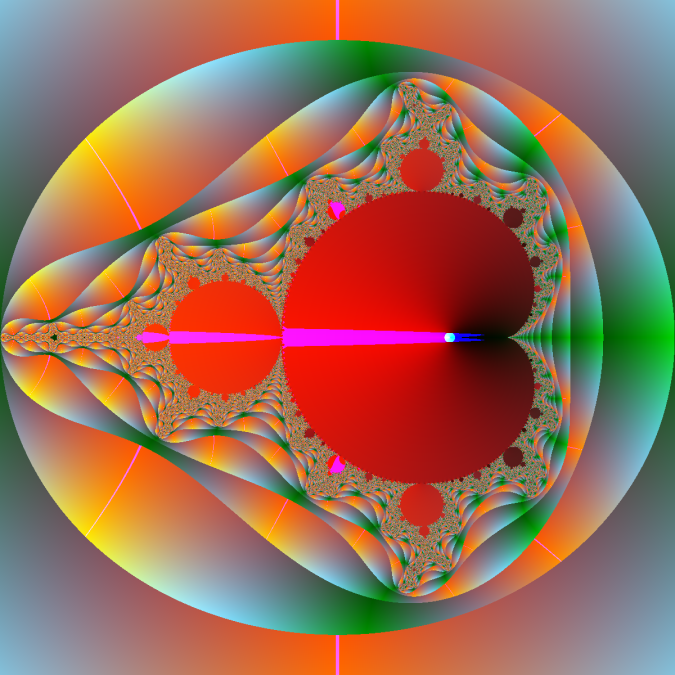
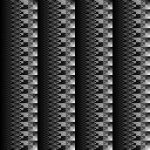
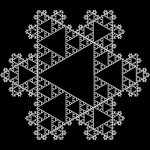
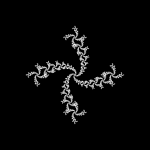
These fractals were generated by Python programs from the Active State website. They often make use of recursion.
Recursion is the process of repeating items in a self-similar way. For instance, when the surfaces of two mirrors are exactly parallel with each other, the nested images that occur are a form of infinite recursion. The term has a variety of meanings specific to a variety of disciplines ranging from linguistics to logic. The most common application of recursion is in mathematics and computer science, in which it refers to a method of defining functions in which the function being defined is applied within its own definition. Specifically, this defines an infinite number of instances (function values), using a finite expression that for some instances may refer to other instances, but in such a way that no loop or infinite chain of references can occur. The term is also used more generally to describe a process of repeating objects in a self-similar way. (wikipedia)
Python is an easy language to get started with> Here’s an example program to generate the Mandelbrot Set (or rather, an image of an approximation!):
#   Python+Pygame program to illustrate computing the Mandelbrot Set.
#   Note that it's far from efficient; it can easily be sped up!
import pygame                                       # see pygame.org
width, height = 1000,1000                           # display window size
screen = pygame.display.set_mode((width, height))   # initialise pygame window
xaxis = width / 1.5 + 140                           # scaling for x & y axes
yaxis = height / 2
scale = 400
maxit = 99                                          # maximum iterations
for iy in range(height/2+1):                        # scan y-axis
    for ix in range(width):                         # scan x-axis
        z = 0 + 0j                                  # initialise z=0
                                                    # map pixel position to complex plane
        c = complex(float(ix - xaxis) / scale, float(iy - yaxis) / scale)

        for it in range(maxit):                     # up to maximum iterations:
            z = z*z + c                             # iterate z^2 + c
            if abs(z) > 2:                          # z is flying off to infinity!
                col=(it % 4 * 64, it % 8 * 32, it % 16 * 16)    # pick a colour
                break                               # break out of closest loop
        else:                                       # loop finished so
            col = (0, 0, 0)                         # point is in set = colour black

        screen.set_at((ix, iy), col)                # set colour on top half
        screen.set_at((ix, height-iy), col)         # set colour on bottom half
    pygame.display.update()                         # update window on screen
raw_input("Done")                                   # picture disappears when Enter
The pictures in the gallery were generated by the following programs:
- sfplust
- percolation
- newtonFr
- Fern
- RandomSpiralFractal_7 RandomSpiralIFSFractal
- LogisticMapFractal
- MandelbrotFractal
- Bifurcation
- CircleInversionFractal
- Apollonian Gasket
These fractals were generated by Python programs from the Active State website. They often make use of recursion.

Im getting an error in Line 19:
What does the “& gt; 2:” do?
Im not understanding this part.
That should have been rendered as a greater than sign, i.e. > 2
Sorry for that, pls try again.